The more things change, the more they stay the same. The past month has given us the rebirth of New Zealand as a legitimate top-tier force and the continuing rise of Pasifika rugby league with Samoa and Tonga – but in the end the one thing that really matters is the one thing that does not look like changing any time soon.
For the 10th time in the past 11 editions, the men's Rugby League World Cup belongs to Australia. What we saw in Brisbane was not so much a surprise – the Kangaroos saving their best for when it really mattered – but more a disappointment, given the pre-match hype and the contest between these two on the opening night. That game four weeks ago was won by two points and although Australia looked below par and perhaps even slightly vulnerable in the tournament's early moments, it was the Kiwis' display which gave neutrals the greatest cause for optimism that a team could finally dethrone the Kangaroos. Perhaps this was finally the time, after England and Samoa failed in the past two finals.
But here is the thing about Australia's rugby league team, one of the greatest and most dominant forces in world sport: when the stakes are at their highest, the Kangaroos find a level few can match. Yes, New Zealand failed to deliver in that regard themselves in Brisbane but they were helpless at times to try to match the world champions both with and without the ball.
The tone was set on the very first play, with New Zealand's kick-off sailing out on the full. While they held back the tide for 15 minutes, even levelling the scores early on after Casey McLean cancelled out Liam Martin's early try, what followed felt inevitable. By half‑time Australia were 24-6 ahead.
New Zealand had no answer in the second half. What has been a successful tournament across most of the metrics probably deserved a better ending, and the Kiwis were certainly underwhelming. Perhaps the occasion got to them, something that rarely troubles the Kangaroos. Perhaps the gap to Australia is still as big as we thought pre-tournament.
Even if Stacey Jones's team had produced their best, it is fair to assume this outcome would have remained the same. Australia rarely need any extra motivation but their players broke rank in the buildup and admitted that talk of New Zealand having the better forward pack was a sign of disrespect. They clearly leaned into that motivation.
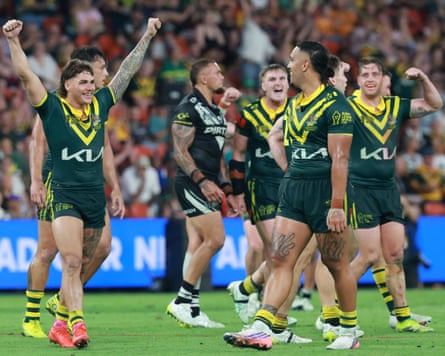
"We had a plan at the start of the tournament and we executed that plan beautifully," the victorious coach, Kevin Walters, said. "We've been criticised for a lot of things but this is a 23-man squad that everyone contributed to. The big teams win the big moments and the players were brilliant."
The Kangaroos' critics were silenced in a blistering first half. After Martin and McLean exchanged early tries, Australia clicked into gear in ruthless fashion. Reece Walsh was at the heart of everything they did well, with his involvement crucial in the try that put the Kangaroos back ahead, finished by Jack Bostock.
By half-time they had scored two more tries and were aided by both the profligacy in attack from the Kiwis and repeatedly handing Australia field position. The pressure had to tell eventually, with Bradman Best touching down before Martin struck a telling blow two minutes before half-time, as he claimed his second to make it 24-6.
Half-time did not yield a change in momentum. Just three minutes after the restart, the electrifying Walsh danced his way around a visibly tiring New Zealand defensive line before giving Tom Trbojevic a free run to the corner. On this ground in 2008, the Kiwis scored 22 unanswered points to stun the Kangaroos and win the World Cup final; a repeat this time never felt likely.
By the time Isaiah Papali'i scored New Zealand's second with 15 minutes remaining, numerous other chances had passed them by and time had arguably already run out. The Kangaroos had the opposition at arm's length, and when Bostock marked a superb individual tournament with his second try of the final the Australian celebrations had already begun in the stands.
The general consensus across the world game remains that anyone other than Australia becoming world champions would be a good outcome for the sport. But try telling anyone of a green and gold influence and see if they care about that. Maybe 2030 will produce greater Samoa and Tonga teams. Maybe England will wake up to their failings back home.
But they are problems for those nations, not for Australia. They remain the ruler supreme of international rugby league.